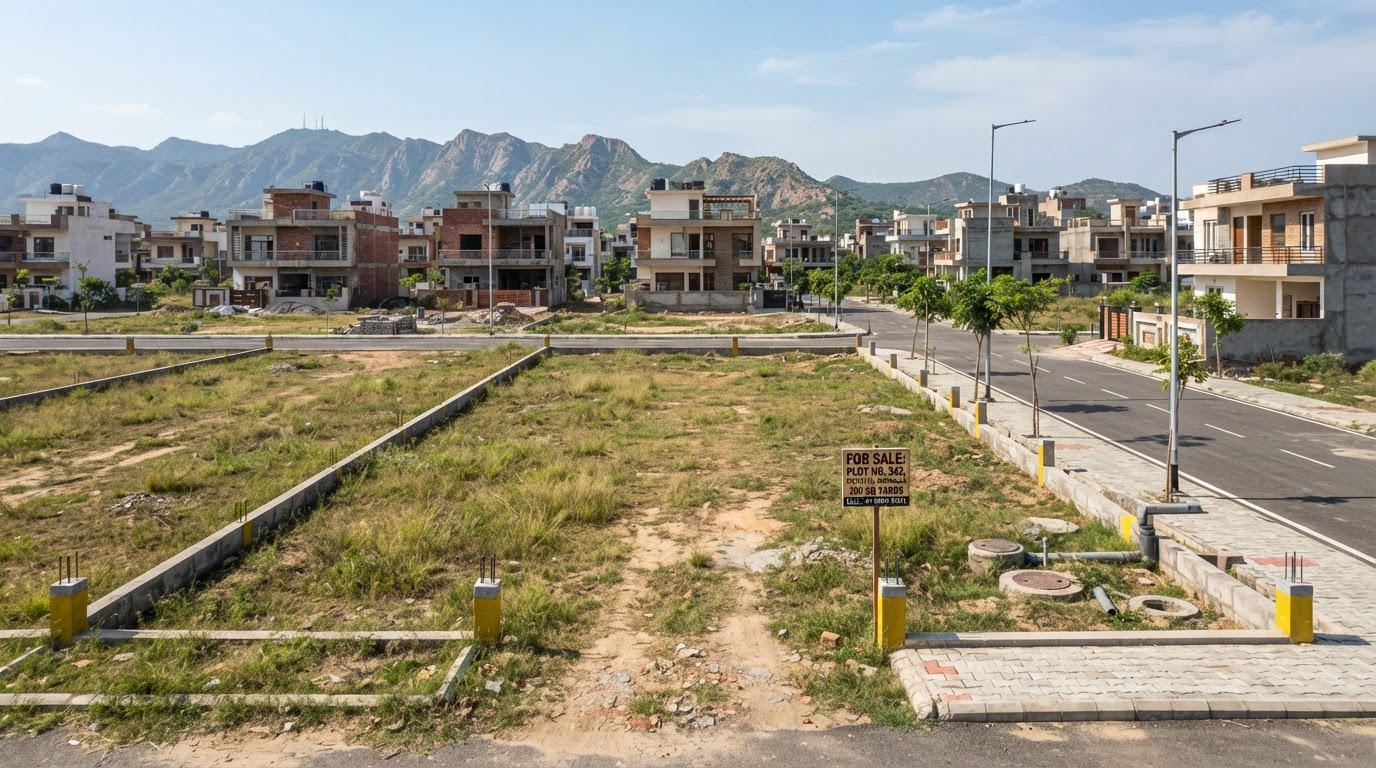
One of the most common questions I hear from investors in Panchkula is whether to put money into a plot or into built property. After three decades of watching both perform, the honest answer is that they grow value in fundamentally different ways — and the better choice depends entirely on your goal, your horizon and your appetite for ongoing cost. There is no universal winner, only the asset that fits your strategy.
Plots offer pure land-value appreciation. When you buy a plot, you are buying land without the complications of a structure — no construction to maintain, no depreciation of the building, no tenant wear and tear. Over a long horizon, land in a well-located, developing or improving pocket can appreciate meaningfully as infrastructure and demand arrive. The trade-off is that a plot produces no income while you hold it; the return is entirely in appreciation, and it takes patience.
Built property — an apartment, a builder floor, an independent house — combines land value with a structure. The land component appreciates; the structure depreciates over time. The advantage is that built property can generate rental income while you hold it, which can cover holding costs and provide cash flow. The disadvantage is that the building ages, requires maintenance, and eventually needs renovation or rebuild, which eats into the net return.
The horizon question is decisive. Over a short to medium horizon, built property often feels safer because the rental income offsets carrying costs and the asset is immediately usable. Over a long horizon, well-located land tends to appreciate more cleanly because there is no depreciating structure dragging on the value. Investors with a ten-to-fifteen-year horizon and no need for income often favour plots; investors who want income or sooner liquidity favour built property.
Location quality matters even more for plots than for built property. A plot in a genuinely improving corridor — where roads, civic works and demand are progressing — can appreciate strongly. A plot in a stalled or poorly connected pocket can sit for years with little movement, because there is no rental income to reward the wait. Plot investors must underwrite the location's trajectory, not just its current price, and that requires local, current knowledge.
Liquidity differs sharply between the two. Built property, particularly apartments and builder floors in established sectors, tends to sell more quickly because the buyer pool is larger — end-users and investors both buy ready property. Plots have a narrower buyer pool and can take longer to sell, especially in developing pockets. Investors who may need to exit quickly should weigh this honestly; plots reward investors who can afford to wait for the right buyer.
Holding costs are the quiet factor. A plot carries minimal ongoing cost — perhaps boundary maintenance and property tax. Built property carries maintenance, repairs, society charges, vacancy risk and sometimes loan interest. Over years, these costs compound and reduce the net return on built property, even when the gross appreciation looks strong. A fair comparison must net out holding costs, not compare gross figures alone.
Documentation and title clarity are critical for both, but plots carry a specific risk: boundary disputes and unapproved land use. A plot's value depends on clear boundaries, approved land use and clean title. Agricultural land converted for residential or commercial use must have the proper change-of-land-use documentation. A plot with unclear boundaries or unapproved use can be nearly impossible to sell at fair value, regardless of its location.
Diversification is often the wisest answer for investors with the capital to spread across both. A built property provides income and liquidity; a plot provides long-horizon appreciation. Holding both balances the portfolio against the weakness of either asset alone. Even within built property, spreading across sectors reduces the risk of one street or one tenant profile dominating your return.
The takeaway is to match the asset to your strategy. If you want income, liquidity and a usable asset, built property in a strong sector is usually the better fit. If you want pure appreciation, can tolerate no income and have a long horizon, a well-located plot in an improving corridor can grow your capital more cleanly. Pair either with clean title and local advice, and you have the grounded approach that has served Panchkula investors for thirty years.